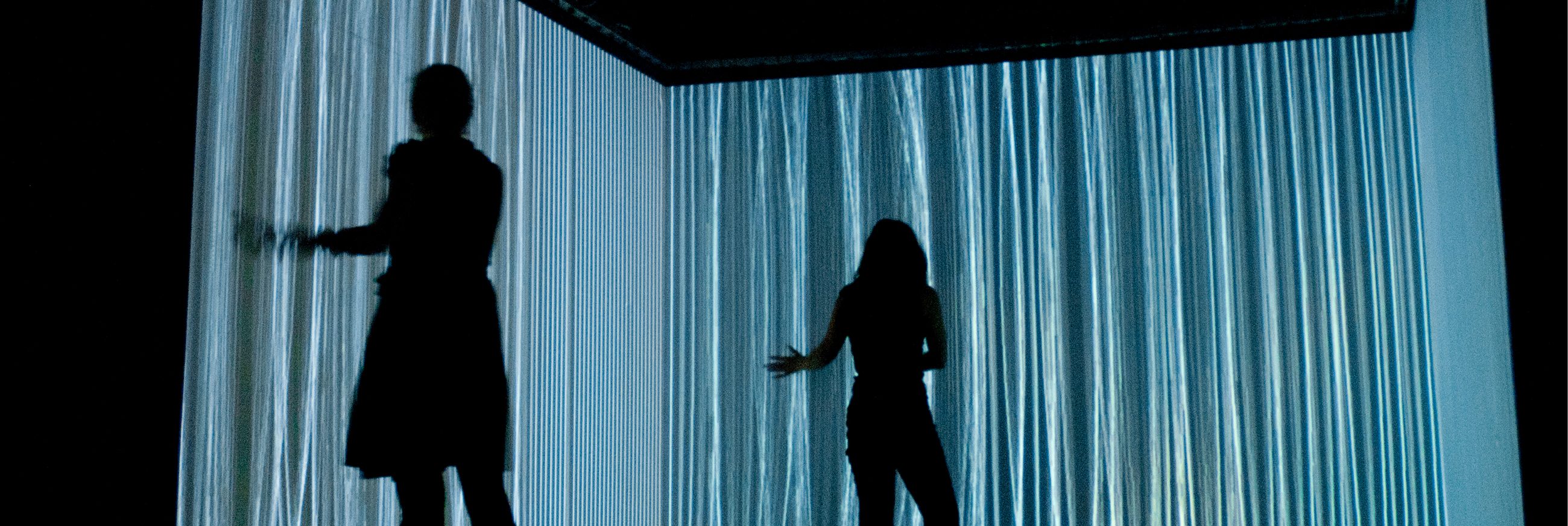
OP_ERA [1999–2007] was an inquiry into space-time: artistic, scientific, and perceptual. Rooms you could see sound in. Walk into and feel a fourth dimension.
Co-created by Daniela Kutschat and Rejane Cantoni, the project built human–machine interfaces to answer a question: how can a human body experience and interact with abstract concepts of space and space-time — a hypercube, a Lorenz attractor, a sonic geometry, the first, the second, the fifth dimension — and come to know them through perception, rather than through description?
Between 1999 and 2007, eight distinct answers were implemented and exhibited nearly forty times, across eighteen cities [Beijing, Belo Horizonte, Brasília, Buenos Aires, Curitiba, Gijón, Irvine, Karlsruhe, Lima, Lisbon, Mexico City, Moscow, Paris, Porto Alegre, Puebla, Recife, Rio de Janeiro, São Paulo] and eleven countries [Argentina, Brazil, China, France, Germany, Mexico, Peru, Portugal, Russia, Spain, the United States]. Through purpose-built apparatus, visitors entered models of space-time. The tools didn't exist before. We built them.
Conceived as a set of conceptual projects and experiments, OP_ERA comprised the research of scientific and artistic models of space and space-time; the building and development of human–machine interfaces, in hardware and software, through which human and artificial agents were symbiotically interconnected; and the creation of alternative forms of spatial perception and cognition through multisensory immersion, interaction, and experimentation with conceptual space-time models.
Implementations
OP_ERA (2001)
OP_ERA: A Journey (2003)
OP_ERA: Haptic Interface (2004)
OP_ERA: Haptic Wall (2004)
OP_ERA: Hyperviews (2004)
OP_ERA: Sonic Dimension (2005)
OP_ERA: Sonic Interface (2006)
OP_ERA: Haptics for the 5th Dimension (2006–2007)
Collections
Works from OP_ERA are held in the collections of Itaú Cultural (São Paulo) and ZKM | Center for Art and Media Karlsruhe.
Awards
Prêmio Transmídia (Itaú Cultural, 2002).
4º Prêmio Sergio Motta (2003).
Beall Center for Art and Technology Award (2005). Transitio_MX, 1st Festival Internacional de Artes Electrónicas y Video (2005).
In addition, OP_ERA comprised the curatorial cycle Interactividades: arte, ciência e tecnologia and the experiments Máquinas de Ver (2001–02).]